Home
Solutions
PulseAbout usContactCompliance & reporting
Energy consumption monitoringISO 50001CSRD / Scope 2Energy invoice verificationRenewables & flexibility
PPA contractA logistics facility uses less energy per square metre than a manufacturing plant. What it has instead is an unusually large share of demand whose timing is decided by the operator rather than by a process: fleet charging, ventilation, pre-cooling the cold store. The savings potential here is therefore larger than the size of the bill alone would suggest.
Round-the-clock operation, a large area to heat and light, and a fast-growing electric fleet add up to a bill that rarely gets questioned. A substantial part of it, however, falls on loads that can be moved in time — and that is where the room for optimisation is.
Most operators run more than one facility, so the same patterns of waste repeat across the whole portfolio.
Harder than the actual activity in the building requires.
Heating and cooling work against one another in neighbouring zones.
Where nobody is picking or packing at that moment.
None of these is dramatic on its own. Across tens of thousands of square metres of warehouse space it becomes a standing cost.
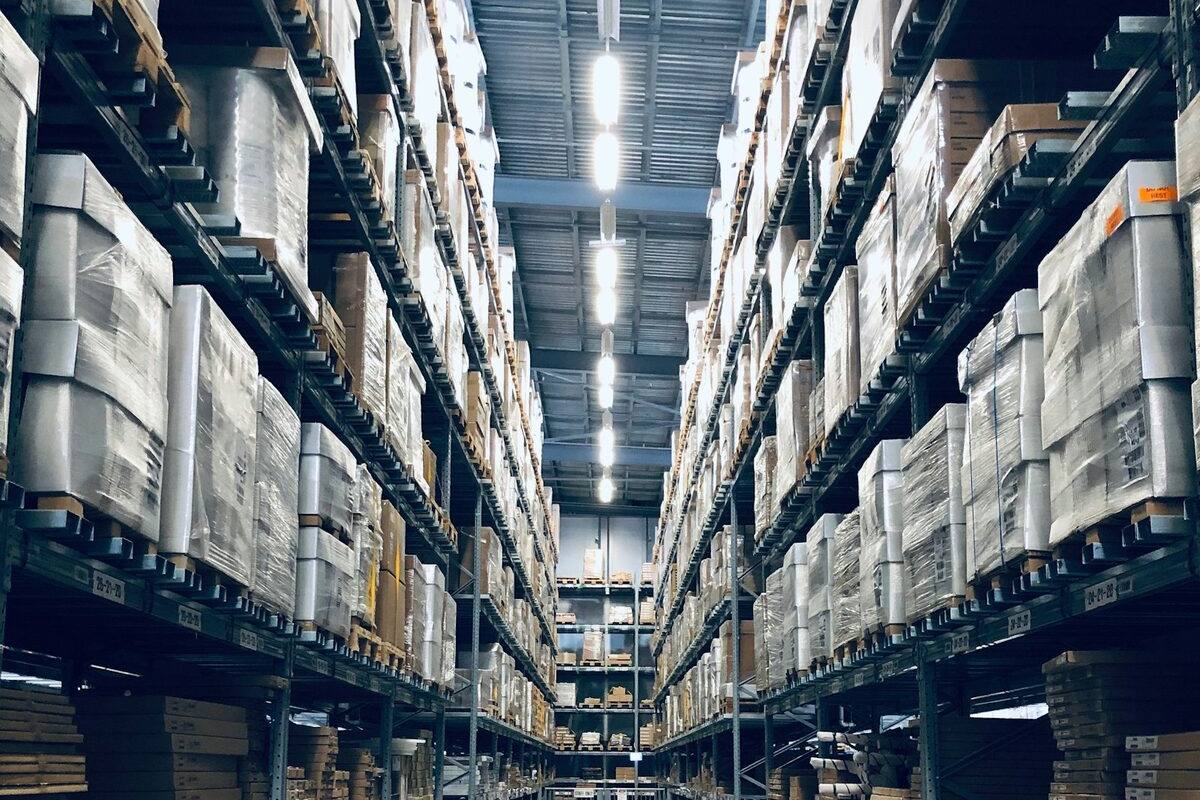
An aisle lit at full output. Nobody is picking in it right now.
On top of that comes a hard constraint on the refrigeration side: in temperature-controlled logistics, product quality and safety cannot be compromised. The cooling has to happen — it does not have to happen in the most expensive hour of the day.
Electric forklifts, and increasingly delivery vehicles too, are becoming standard. Each one needs charging — and if they all charge at once at the end of a shift, the result is a peak that can exceed the site's contracted capacity and trigger penalty charges.
The energy the fleet needs cannot be avoided. The moment at which the fleet draws power can be. And that moment is what decides the cost.
Controlling the charging works on three levels at once, and each one touches a different line on the bill.
Contracted capacity. The system watches the instantaneous demand of the whole site, so the chargers take whatever headroom happens to be free. The peak never forms, and neither do the penalty charges for exceeding the limit.
Capacity charge. Its level does not depend on how much energy the site consumes, but on how uneven the draw is between day and night — the flatter the profile, the lower the rate. Charging in the night window evens that profile out instead of sharpening it.
The price of energy. Charging moves to the cheapest windows of the day, coordinated with dynamic prices and the shift schedule.
A site with its own PV installation has additional room here. Peak generation falls in the middle of the day, so the fleet will rarely absorb all of it — it is out working. Percee® directs the surplus wherever there is room for it: to vehicles and forklifts on rotation or in reserve, and above all to the cold rooms, which can be pre-cooled to hold that energy as a reserve of cold for the evening. Self-consumption rises without a separate investment in energy storage.
The fleet charges when energy is cheap and capacity headroom is available — not when the last driver happens to plug in.
Percee® coordinates HVAC with what is actually happening inside the warehouse: which zones are active, when picking and packing are under way, when a given station is idle. Lighting follows the real working zones — aisles in use are lit, unused ones dimmed.
In a building of this size, simply matching climate control and lighting to actual activity removes a substantial layer of waste — and nobody on the floor notices the difference. Over time the system learns the operation: it anticipates demand, prepares spaces before they are needed, and switches equipment off when they are not.
A cold store holds its temperature, so it can be pre-cooled in off-peak hours and eased off during the expensive peak — always within the ranges the products require. Defrost cycles avoid the peak demand windows, and the compressors do not all start at once when there is a risk of exceeding contracted capacity.
Assets bought as a safeguard start earning their keep.
An energy store charges when energy is cheap and gives it back when it is expensive. Where the operator takes part in demand-side response programmes, that same controllable flexibility — fleet charging, refrigeration and storage together — becomes an additional source of revenue.
How energy cost optimisation works →Logistics rests on a promise of uninterrupted operation, so standby generators and energy storage are already part of the picture. Managed badly, they are expensive assets standing idle. Managed well, they deliver reliability and cost optimisation at the same time.
Centralised dashboards give a view of the entire portfolio together with automatic benchmarking, so facilities can be compared, the weaker performers identified, and proven settings carried from the best locations to the rest.
When a facility shows an unusual consumption pattern, the team gets an immediate alert — often catching a refrigeration fault, a jammed damper or a charger drawing power when it should not, before it turns into downtime or spoiled goods.
Reporting as a by-product, not an annual scramble:
General-purpose automation was designed with single office buildings in mind. A logistics operation is industrial-grade complexity replicated across a distributed, continuously running network.
| Office building | Logistics facility | |
|---|---|---|
| Operating hours | office hours | 24/7, without a break |
| Flexible loads | minimal | EV fleet, refrigeration, energy storage |
| Peak demand risk | low | the whole fleet charging at once |
| Hard constraint | comfort | service levels and product quality |
| Number of sites | one | a distributed network, still growing |
Percee® is hardware-independent, so it integrates with the BMS, meters, sensors and controllers the facility already owns. It is also multi-vector — it optimises electricity, heating, cooling and the remaining flows together, which matters in a building where refrigeration, ventilation, charging and process loads all act on one another.
No. Readiness for the next shift is a hard condition for the system, not a variable. Percee® knows the operating schedule and plans charging so the batteries are ready on time — it changes only how the demand is spread across the window between shifts, so that no single high peak forms.
From April 2026, an additional supply point with its own meter and its own contract can be created on an existing connection — provided the combined capacity does not exceed the connection capacity and the installations are physically separate. That makes it possible to put only the flexible loads on a dynamic tariff, leaving the critical ones on a stable rate. This is particularly valuable in logistics, because the split is unusually clean here: fleet charging, ventilation and pre-cooling are entirely deferrable, while maintenance refrigeration, warehouse automation and safety systems have to run without interruption. The flexible part of a warehouse can be large enough that putting it on a dynamic tariff changes the bill more than it would in a typical building.
The typical reduction in energy costs falls between 20 and 30%. At facilities with a large electric fleet and refrigeration, the share coming from load shifting alone is higher, because more of the demand can be moved in time. We start with an analysis of the profile and the share of deferrable loads.
No. The optimisation covers only loads that can be moved without affecting throughput: charging in the window between shifts, pre-cooling, ventilation in inactive zones. Anything that touches service levels or product quality stays outside its reach.
Building, fleet, refrigeration, energy storage and the market — coordinated together, every day.
Percee® does not monitor the facility and produce a report for somebody to act on later. It takes over automatic control of the whole operation, holding service levels and product quality while removing demand peaks and moving deferrable loads to the cheapest hours.
 EN
EN PL
PL