Home
Solutions
PulseAbout usContactCompliance & reporting
Energy consumption monitoringISO 50001CSRD / Scope 2Energy invoice verificationRenewables & flexibility
PPA contractEnergy bills in commercial and industrial facilities rise faster than the budgets meant to cover them. Tariffs grow more complex, demand and capacity charges penalize peak draw, and HVAC and lighting systems often run on rigid schedules that do not react to what is actually happening in the building.
Percee® is an Energy Management and Optimization System (EMOS) that automatically controls electricity consumption based on measurement data from the facility — with no infrastructure replacement and no constant operator supervision. This page explains how that control works in practice: which equipment it covers, how much it really saves, and how a rollout proceeds.
The usual answer to high energy bills is a list of one-off measures. Each helps once, and then its potential is exhausted:
These actions lower the starting point, but nothing keeps consumption low over time: occupancy changes, setpoints drift, faults appear. The durable difference comes from control that runs every day — which is what the rest of this page is about.
Most facilities have three systemic problems with energy cost. They usually stem not from outdated equipment, but from a lack of information and automation in the decision layer.
The platform collects data from meters, sensors and BMS controllers at 15-minute intervals, then makes autonomous control decisions — within the comfort and safety parameters defined by the operator.
This is an important limit. The algorithm will not switch off ventilation in a production hall if it would affect the process, and will not lower the temperature in a cold store below the permitted threshold. But within the range agreed in advance, it adjusts how equipment runs to achieve concrete financial benefits.
Percee analyzes outdoor and indoor temperature, humidity, CO₂ concentration, zone occupancy and the weather forecast — and on that basis adjusts air conditioning and ventilation to actual demand.
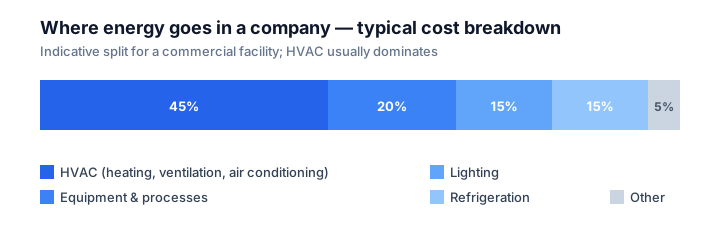
Instead of a fixed schedule, it adapts continuously. When a warehouse is 30% loaded, ventilation output drops proportionally — the system does not maintain a full air exchange without need. In office buildings, HVAC responds to real floor occupancy and CO₂ levels, not to a theoretical lease schedule. Since HVAC is often 40–60% of energy cost in commercial buildings, this is where the single largest reduction arises.
Lighting in logistics halls and production plants is often 10–15% of total consumption. Percee controls lighting groups based on presence sensors and daylight levels, taking the tariff into account.
During peak hours the priority is to reduce draw. Outside peak the algorithm works less aggressively — artificial light supplements daylight only where and when it is actually needed.
In many markets, commercial users pay not only for energy but also a charge tied to peak demand or to how peaky their load profile is. The flatter and better-timed the profile, the lower this charge — and it is one of the few cost items a facility can genuinely influence through operation rather than capital spend.
Percee monitors current draw and automatically shifts selected loads out of peak windows — for example vehicle charging, water heating, or pre-cooling a cold store ahead of the peak. The condition is clear: a 30–60 minute shift must not affect the operational process.
The same mechanism can reduce two different items on the bill — peak/capacity charges and, under a dynamic tariff, the energy price itself. Note: the economic signals from these two mechanisms can conflict, which is why Percee optimizes the total cost, not a single component.
The platform does not send alerts asking for approval. It works within defined rules and makes control decisions itself. The operator sees each one in the logs and can change parameters at any time — but does not have to sit in front of a screen for optimization to happen. That is a concrete difference from dashboards that show data but control nothing.
Based on deployments so far, the typical reduction in electricity cost is 15–30%. The result depends on the facility type, the state of automation and the tariff structure. Return on investment (ROI) usually follows within 6–18 months — the shorter end applies to facilities with a high share of HVAC and refrigeration in their costs.
Every saving is calculated with measurement and verification (M&V) — against a baseline and EnPI indicators, consistent with ISO 50001 logic. The result is therefore verifiable, not merely declared.
For a 5,000 m² facility with a monthly energy bill of €12,000, a 15% reduction means a saving of €1,800 per month, and 30% means €3,600. Over a year that is €21,600 to €43,200, returning to the operating budget with no change to the process and no investment in new equipment.
The exact amount depends on the consumption profile, tariff structure and available automation — which is why every deployment begins with an analysis of measurement data from the specific facility.
The platform is designed for facilities where monthly electricity costs run into the tens of thousands, and where cost arises from many subsystems working at once.
Details of deployments by sector: solutions for industries.
Percee runs on existing hardware. It does not require replacing controllers, meters or the BMS — integration is via BACnet, Modbus, OPC UA or vendor APIs. Where a facility has a SCADA system, data flows from there into Percee with no extra hardware layer.
A rollout proceeds in three stages:
No vendor lock-in: the data remains the client's property, and Percee works with any measurement and control hardware that supports standard protocols. Changing your automation supplier does not mean losing optimization. The full scope — from monitoring to control — is described on the Percee platform page.
Energy optimization is also the foundation of formal energy efficiency. For companies subject to a mandatory energy audit or to energy-management obligations (such as the EU Energy Efficiency Directive), the platform supplies data and reports aligned with the standard's requirements. In some markets, efficiency measures can also qualify for energy-efficiency certificate ("white certificate") schemes, further shortening payback. More: ISO 50001-aligned system.
The starting point is measurement — without data you cannot tell where losses arise. The next step is automated, real-time control of the areas with the largest potential (usually HVAC, refrigeration, lighting). One-off measures (LED, retrofits, new equipment) lower the starting point, but only continuous control keeps it there.
The cost depends on the consumption profile, tariff structure and available automation, which is why every deployment starts with a free data analysis. The reference point is a return on investment in 6–18 months — shorter at facilities with a high share of HVAC and refrigeration.
Monitoring shows where and how much energy a facility uses, but controls nothing. Optimization goes further: based on the same data, it automatically changes how equipment runs in order to lower cost. Monitoring is therefore the first step, not the goal in itself.
No. Percee integrates with existing meters, controllers and the BMS via standard protocols (BACnet, Modbus, OPC UA, API). There is no vendor lock-in, and the data remains the client's property.
Order a free analysis of your company's data. We will show what the absence of automated optimization is costing you — on your meters, in your tariff, with your consumption profile.
 EN
EN PL
PL